

Last updated on April 22nd, 2026 at 07:07 am
Disclaimer: This post contains affiliate links. If you buy through these links, we may earn a small commission at no extra cost to you. As an Amazon Associate, I earn from qualifying purchases.
Solar attic fan installation is one of the most effective ways to tackle a hot attic and rising cooling bills without increasing your energy usage. If your home feels like an oven during summer and your AC struggles to keep up, poor attic ventilation is likely the hidden problem driving up your costs.
That’s where solar attic fan installation makes a real difference. By using free solar energy to push out trapped heat, these fans help lower attic temperatures, reduce strain on your cooling system, and improve overall home comfort—without adding to your electricity bill.
In this guide, you’ll learn exactly how to install a solar attic fan step-by-step, along with the tools you need and the common mistakes to avoid. We’ll also review the 5 best solar attic fans you can buy today so you can choose the right one and start saving energy as soon as possible.
Benefits of Solar Attic Fan Installation
Solar attic fan installation offers a smart and energy-efficient way to keep your home cooler while reducing long-term costs. By actively removing trapped heat from your attic, it prevents your living spaces from overheating and reduces the workload on your air conditioning system.
This directly translates into noticeable savings on your monthly electricity bills, especially during peak summer months when cooling demand is highest. Another major advantage of solar attic fan installation is improved attic ventilation, which helps regulate moisture and prevents issues like mold growth, wood rot, and insulation damage.
A well-ventilated attic also protects your roofing materials from excessive heat buildup, extending the lifespan of your roof and reducing maintenance costs over time.
Here are the key benefits at a glance:
- Lower electricity bills by reducing AC usage
- Better attic ventilation for improved airflow
- Longer roof lifespan due to less heat damage
- Eco-friendly cooling powered by solar energy
Overall, installing a solar attic fan is a cost-effective upgrade that enhances comfort, protects your home, and supports a more sustainable lifestyle.
Tools and Materials Needed for Solar Attic Fan Installation
Before starting your solar attic fan installation, having the right tools and instruments ready will make the process smoother, safer, and more efficient. Proper preparation not only saves time but also ensures a secure and leak-free installation, which is critical for long-term performance.
For a successful solar attic fan installation, you’ll need a combination of cutting, fastening, and sealing tools. A drill machine is essential for creating pilot holes and securing the fan unit, while a jigsaw or reciprocating saw helps you cut the roof opening accurately.
Roofing sealant plays a crucial role in preventing water leaks, and a sturdy screws and mounting kit ensures the fan stays firmly in place even during harsh weather conditions.
Here’s a quick checklist of what you’ll need:
- Drill machine for drilling and fastening
- Jigsaw or reciprocating saw for cutting the roof opening
- Roofing sealant to prevent leaks and ensure durability
- Screws and mounting kit for secure installation
- Safety gear (gloves, goggles, harness) for protection
Having these tools on hand will help you complete the installation efficiently while maintaining safety and quality.
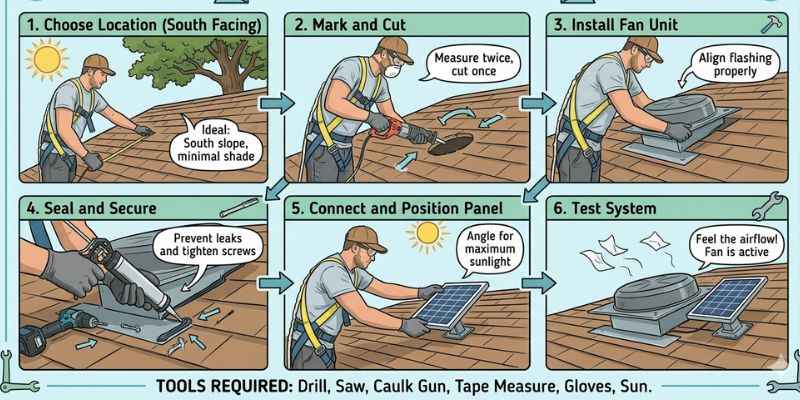
How to Do Solar Attic Fan Installation Step-by-Step
A proper solar attic fan installation ensures maximum airflow, better cooling efficiency, and long-term durability. Follow these detailed steps carefully to install your solar attic fan the right way and avoid costly mistakes.
Step 1 – Choose the Right Location
The placement of your fan plays a crucial role in the success of your solar attic fan installation. Ideally, choose a spot on a south-facing section of your roof, as it receives the most sunlight throughout the day. This allows the solar panel to generate maximum power and keeps the fan running efficiently.
Avoid areas that are shaded by trees, nearby buildings, or roof structures like chimneys and vents. Also, position the fan near the highest point of the attic where hot air naturally accumulates. Proper placement ensures optimal ventilation and better heat removal.
Step 2 – Mark and Cut the Roof Opening
Once you’ve selected the location, carefully mark the area where the fan will be installed. Use the template provided by the manufacturer to trace the exact dimensions on the roof surface.
Before cutting, double-check measurements to ensure accuracy. Using a jigsaw or reciprocating saw, cut the opening slightly smaller than the fan base to ensure a snug fit. Work slowly and precisely to avoid damaging surrounding roofing materials. This step is critical, as an incorrect cut can lead to poor installation and potential leaks.
Step 3 – Install the Fan Unit
Now it’s time to place the fan unit into the opening. Gently position it so that it fits securely into the cut hole. Make sure the flashing (the metal base around the fan) sits flat against the roof surface.
Proper alignment of the flashing is essential to direct water away from the opening and prevent leaks. Slide the upper portion of the flashing under the roof shingles while keeping the lower edge on top. This overlapping technique ensures proper water drainage and weather protection.
Step 4 – Seal and Secure the Fan
To make your solar attic fan installation watertight, apply a high-quality roofing sealant around the edges of the flashing. Focus on sealing all gaps where water could potentially enter.
After sealing, use screws from the mounting kit to secure the fan firmly to the roof. Tighten them evenly, but avoid over-tightening, which could damage the flashing or roofing material. A well-sealed and secured fan will withstand rain, wind, and temperature changes without issues.
Step 5 – Connect and Position the Solar Panel
If your solar attic fan comes with a separate solar panel, mount it in a location that receives direct sunlight for most of the day. Angle the panel toward the sun (typically south-facing in most regions) for maximum energy generation.
Secure the panel using the provided mounting hardware and connect the wiring according to the manufacturer’s instructions. Ensure all connections are tight and protected from weather exposure. Proper positioning of the solar panel is key to maintaining consistent fan performance.
Step 6 – Test the System
After completing the installation, test the system to ensure everything is working correctly. On a sunny day, the fan should start running automatically once the solar panel receives enough sunlight.
Check for strong airflow inside the attic and listen for any unusual noises. Also, inspect the installation area for gaps or loose components. Testing confirms that your solar attic fan installation is functioning efficiently and ready to deliver long-term cooling benefits.
Common Mistakes to Avoid During Solar Attic Fan Installation
Even though solar attic fan installation is a relatively straightforward DIY project, small mistakes can reduce efficiency or lead to costly repairs later. Understanding these common errors will help you get the best performance and long-term benefits from your installation.
One of the biggest mistakes during solar attic fan installation is placing the fan or solar panel in a shaded area. Since the system relies entirely on sunlight, even partial shade can significantly reduce performance. Another common issue is poor sealing around the flashing, which can cause roof leaks over time and damage your attic structure.
Here are the key mistakes to avoid:
- Installing in shaded areas that limit solar power generation
- Poor sealing, which can lead to water leaks and roof damage
- Choosing the wrong fan size for your attic space
- Ignoring roof pitch, which affects proper installation and drainage
Taking the time to avoid these mistakes will ensure your solar attic fan operates efficiently, lasts longer, and delivers maximum energy savings.
1. VEVOR 42W Solar Attic Fan
The VEVOR 42W model stands out for solar attic fan installation thanks to its powerful 2800 CFM airflow and advanced MPPT technology. It maximizes sunlight to remove hot air efficiently, reducing cooling costs fast. The brushless DC motor ensures strong performance with low noise.
What makes it even better is its smart temperature and humidity control with built-in sensors. It automatically adjusts airflow and even includes smoke detection for added safety. Plus, the remote control makes operation simple and convenient from a distance.
For reliable solar attic fan installation, this fan works 24/7 by switching to electric mode after sunset. Its weatherproof, adjustable solar panel captures maximum sunlight, making it perfect for consistent attic ventilation in all conditions.
🔑 Key Features
- Power Output: 42W
- Airflow Capacity: 2800 CFM
- Motor Type: Brushless DC Motor
- Solar Technology: MPPT Controller
- Temperature Control: Auto On/Off at 26°C
- Humidity Control: Built-in Smart Sensor
- Safety Feature: Smoke Detection Auto Shutoff
- Operation Mode: Solar + Electric Backup
- Remote Control Range: Up to 9.75 meters
- Noise Level: Low-Noise Operation
- Panel Type: Adjustable Angle Solar Panel
- Weather Resistance: Hail & Storm Resistant
- Roof Compatibility: Metal & Masonry Roof
✅ Pros
- High airflow with 2800 CFM
- Smart temperature and humidity control
- Works 24/7 with solar and electric backup
⚠️ Cons
- Slightly higher price than basic models
- Installation may take some effort for beginners
📦 Kit Includes
- Solar attic fan unit
- Solar panel (adjustable)
- Mounting base with flashing
- Remote control
- Power adapter
- Connection cables
2. DC HOUSE 32 Watt Solar Attic Fan
The DC HOUSE 32W model is one of the best solar attic fans for homeowners looking for reliable, cost-free cooling. It runs completely on solar power, helping you cut electricity bills while improving airflow. With up to 2500 CFM airflow, it efficiently removes heat and humidity from large attic spaces.
For smooth solar attic fan installation, this fan is built with a durable aluminum body and a brushless motor for long-lasting performance. It operates quietly at just 43 dB and is fully weather-resistant, making it ideal for all climates. Even on cloudy days, it continues to perform well.
If you want a simple and efficient solar attic fan installation, this unit delivers excellent value. It keeps your attic fresh, supports better ventilation, and works automatically during the day without any manual effort.
🔑 Key Features
- Power Output: 32W
- Airflow Capacity: 2500 CFM
- Coverage Area: Up to 3000 sq ft
- Material: Aluminum
- Motor Type: Brushless Motor
- Blade Size: 9-inch Fan Blades
- Noise Level: 43 dB
- Waterproof Rating: IP68
- Power Source: Solar Powered
- Design Type: Roof Exhaust Fan
- Weather Resistance: Hail & Harsh Weather Resistant
- Dimensions: 20 x 20 x 20 inches
✅ Pros
- High airflow up to 2500 CFM
- Quiet operation around 43 dB
- Durable and weather-resistant build
⚠️ Cons
- Lower capacity vs larger bank batteries
- Needs multiple units for whole-home backup
📦 Kit Includes
- Solar attic fan unit
- Solar panel
- Mounting base with flashing
- Screws and installation hardware
- User manual
3. Hon & Guan 40W Solar Attic Fan with Thermostat
The Hon&Guan 40W model stands out as one of the best solar fans for barns and attics, offering efficient cooling with up to 2000 CFM airflow. It runs on solar energy, helping reduce electricity bills while removing heat and humidity. This makes it a smart choice for improving indoor air quality.
For smooth solar attic fan installation, this fan offers flexible multi-angle solar panel adjustment for maximum sunlight capture. It also supports 24/7 operation with an AC/DC adapter, ensuring consistent ventilation even at night. The built-in thermostat allows automatic temperature-based operation.
If you want reliable solar attic fan installation, this fan delivers durability and performance. With two operating modes and a weatherproof design, it adapts easily to different needs while maintaining strong and efficient airflow.
🔑 Key Features
- Power Output: 40W
- Airflow Capacity: 2000 CFM
- Coverage Area: Up to 2500 sq ft
- Panel Adjustment: 0–70° Multi-Angle
- Operating Modes: 2 Modes (Energy Saving & Performance)
- Thermostat Range: 68–113°F Auto Control
- Power Source: Solar + AC/DC Adapter
- Motor Type: Brushless Copper Motor
- Noise Level: Quiet Operation
- Material: Weatherproof Metal Housing
- Application: Attic, Barn, Garage, Workshop
✅ Pros
- Strong airflow up to 2000 CFM
- Flexible solar panel angle for better sunlight capture
- Works day and night with AC/DC support
⚠️ Cons
- No battery backup option
- Slightly premium price compared to basic fans
📦 Kit Includes
- Solar attic fan unit
- Solar panel (adjustable)
- Mounting base with flashing
- AC/DC adapter
- Control knob / thermostat unit
- Screws and installation hardware
- User manual
4. GROWNEER 40W 14″ Solar Attic Fan with Smart Thermostat
The GROWNEER 40W model is one of the best solar roof fans for reliable and energy-efficient cooling. It uses high-efficiency solar panels with low-light activation, so it keeps running even during cloudy days or early mornings. This makes it a great choice for consistent ventilation without increasing electricity costs.
For smooth solar attic fan installation, this fan offers smart thermostat and humidity control for automatic operation. It adjusts airflow based on temperature and moisture, keeping your attic comfortable year-round. The remote control and 24/7 operation with an adapter add extra convenience.
If you want dependable solar attic fan installation, this fan delivers strong performance with up to 2000 CFM airflow and multiple speed settings. Its waterproof design and durable build make it ideal for long-term use in different environments.
🔑 Key Features
- Power Output: 40W
- Airflow Capacity: Up to 2000 CFM
- Speed Levels: 4 Speeds
- Coverage Area: Up to 2000 sq ft
- Solar Feature: Low-Light Activation
- Operation Mode: 24/7 with Adapter
- Control Type: Remote Control (30m range)
- Thermostat: Smart Temp & Humidity Control
- Activation Temp: Above 26°C / 78.8°F
- Humidity Trigger: Above 60%
- Motor Type: Brushless Motor
- Waterproof Rating: IP68
- Material: Aluminum Alloy
- Fan Size: 14-inch
✅ Pros
- Works even in low light conditions
- Smart thermostat and humidity control
- 24/7 operation with remote convenience
⚠️ Cons
- Slightly complex features for beginners
- Adapter needed for full-time operation
📦 Kit Includes
- Solar attic fan unit
- Solar panel (built-in or attached)
- Mounting base with flashing
- Remote control
- Extension power adapter (for 24/7 use)
- Connection cables
- Screws and installation hardware
- User manual
5. OmniPV 40W Solar Attic Fan
The OmniPV 40W model is a reliable solar vent fan designed to keep your attic cool using clean solar energy. Its 1600 CFM airflow efficiently removes trapped heat, helping reduce indoor temperature and cooling costs. The solar panel maximizes sunlight, making it a smart energy-saving solution.
For easy solar attic fan installation, this fan features a built-in thermostat that automatically turns on and off based on temperature. It ensures consistent attic ventilation without manual effort. The brushless DC motor delivers quiet and efficient performance for everyday use.
If you want a durable option for solar attic fan installation, this unit offers strong weather resistance with its aluminum alloy build. It’s designed for flexible installation on different roof types, making it a practical and long-lasting ventilation upgrade.
🔑 Key Features
- Power Output: 40W
- Airflow Capacity: 1600 CFM
- Motor Type: Brushless DC Motor
- Thermostat: Auto On/Off at 26°C / 77°F
- Power Source: Solar Powered
- Operation Mode: Solar + 110V Adapter
- Noise Level: Low-Noise Operation
- Material: Aluminum Alloy
- Weather Resistance: UV, Corrosion & Waterproof
- Installation Type: Roof / Gable / Vent Mount
- Application: Home, Garage, Workshop, RV
✅ Pros
- Efficient cooling with 1600 CFM airflow
- Quiet and energy-saving operation
- Durable and weather-resistant build
⚠️ Cons
- Lower airflow than some high-power models
- Adapter needed for night operation
📦 Kit Includes
- Solar attic fan unit
- Solar panel
- Mounting base with flashing
- 110V smart adapter
- Connection cables
- Screws and installation hardware
- User manual
How to Choose the Best Solar Attic Fan
Choosing the right fan is essential to get the best results from your solar attic fan installation. Start by checking the CFM (cubic feet per minute), which shows how much air the fan can move. Higher CFM works better for large attics, while smaller spaces need less. Matching the fan size to your attic ensures proper airflow and efficiency.
Another important factor in solar attic fan installation is roof compatibility. Make sure the fan fits your roof type, such as asphalt shingles, metal, or tile. You should also choose between a built-in solar panel or a separate one. Built-in panels are easier to install, while separate panels give better sunlight exposure.
Finally, consider warranty and noise level for long-term performance. A strong warranty shows reliability and protects your investment. Also, choose a low-noise fan if your attic is near living areas, so you get efficient cooling without disturbance.
Conclusion
Solar attic fan installation is a smart and practical way to keep your home cooler while reducing energy costs. By improving attic ventilation and removing trapped heat, it helps your cooling system work more efficiently. Whether you choose DIY or professional setup, the long-term benefits make it a worthwhile investment.
To make your decision easier, we’ve carefully researched and recommended 5 of the best solar attic fans, including reliable options like DC HOUSE, OmniPV, and more. Each of these models offers strong performance, durability, and efficient solar-powered operation.
If you’re ready to improve comfort and cut down on energy bills, now is the perfect time to move forward with solar attic fan installation. Choose the right fan for your needs and start enjoying a cooler, more energy-efficient home.
FAQs: Solar Attic Fan Installation
1. How long does solar attic fan installation take?
Solar attic fan installation usually takes 2–4 hours for a DIY setup, depending on your experience and roof type.
2. Can I do solar attic fan installation myself?
Yes, many homeowners can handle solar attic fan installation with basic tools, but proper sealing and placement are very important.
3. Do solar attic fans work at night?
Most solar attic fans run during the day, but some models come with adapters or backup power for night operation.
4. How many solar attic fans do I need?
It depends on your attic size. Typically, one fan is enough for up to 1500–2500 sq ft, but larger spaces may need more.
5. Is solar attic fan installation worth it?
Yes, solar attic fan installation helps reduce heat buildup, lowers cooling costs, and improves overall home ventilation.