
Last updated on March 7th, 2026 at 05:40 am
Disclaimer: This post contains affiliate links. If you buy through these links, we may earn a small commission at no extra cost to you. As an Amazon Associate, I earn from qualifying purchases.
How to connect solar panel to inverter correctly is one of the most important steps in building a safe and efficient solar power system. A small wiring mistake—like reverse polarity, incorrect voltage matching, or skipping a charge controller—can damage your inverter instantly and lead to expensive repairs.
Many beginners search for how to connect solar panel to inverter but end up confused by technical diagrams and incomplete explanations. Whether you’re installing an off-grid system with batteries or a hybrid inverter for home use, following the proper connection sequence makes all the difference.
In this guide, I’ll walk you through a simple step-by-step method, explain common mistakes to avoid, and help you connect your system safely and confidently. We’ll also recommend 5 of the best inverters for solar panels so you can choose a reliable model that matches your setup perfectly.
What You Need Before Connecting a Solar Panel to an Inverter
- Solar panel
- Solar inverter
- Charge controller (if required)
- Solar battery (optional)
- MC4 connectors
- DC cables
- Circuit breaker / fuse
Can You Connect Solar Panel Directly to an Inverter?
Can you connect a solar panel directly to an inverter? The answer depends on the type of system you’re using. In most cases, you cannot connect a solar panel directly to a standard off-grid inverter because the panel’s voltage fluctuates with sunlight.
If you’re learning how to connect solar panel to inverter, understanding voltage regulation is critical to avoid damaging your equipment.
A direct connection is only possible in specific setups—such as grid-tie inverters with built-in MPPT (Maximum Power Point Tracking) that are designed to accept DC input directly from solar panels.
However, if you’re using an off-grid inverter with batteries, you must use a charge controller between the solar panel and the battery to regulate voltage and prevent overcharging. Skipping this step is one of the most common and costly mistakes people make when figuring out how to connect solar panel to inverter safely.
Here’s the key difference:
An off-grid inverter works with batteries and requires a charge controller.
A hybrid inverter combines inverter and charge controller functions (and sometimes MPPT) in one unit.
A grid-tie inverter connects directly to solar panels and feeds power into the utility grid without batteries.
Choosing the right type determines whether a direct panel-to-inverter connection is safe—or a serious risk.
How to Connect Solar Panel to Inverter (Step-by-Step)
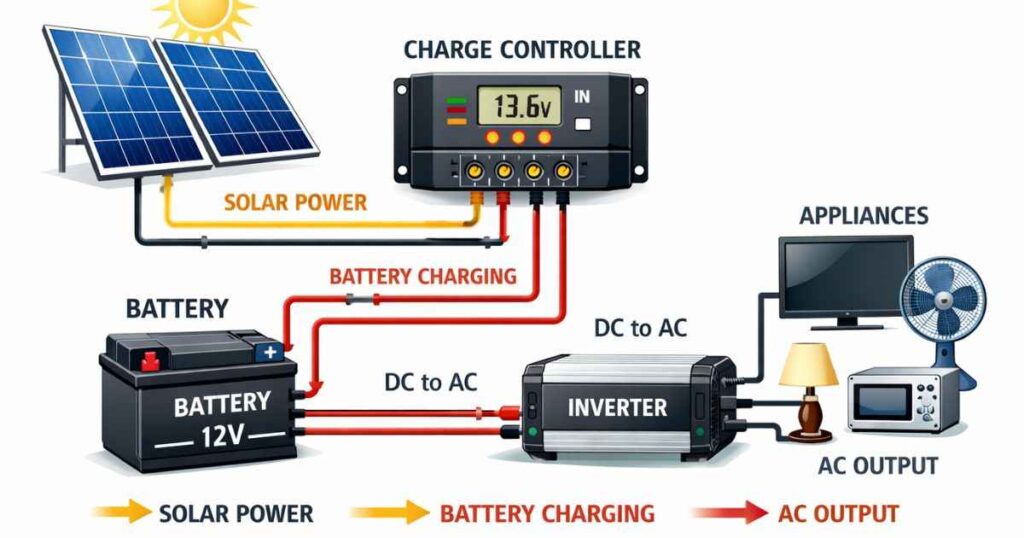
If you’re wondering how to connect solar panel to inverter safely and correctly, follow this simple step-by-step method. The right sequence is extremely important—connecting components in the wrong order can damage your inverter or battery.
Step 1: Turn Off All Equipment
Before starting, switch off the inverter and ensure the solar panel is not actively supplying power (cover it if necessary). This prevents accidental sparks, short circuits, or reverse polarity damage.
Step 2: Connect Solar Panel to Charge Controller
Connect the positive and negative wires from the solar panel to the corresponding PV input terminals on the charge controller. Double-check polarity—positive to positive (+) and negative to negative (–). Incorrect wiring here is a common mistake.
Step 3: Connect Charge Controller to Battery
Next, connect the charge controller to the battery terminals. Always connect the battery before turning the controller on, as most controllers need battery voltage to operate properly and regulate charging safely.
Step 4: Connect Battery to Inverter
Now connect the battery to the inverter using properly sized cables. Make sure the inverter’s voltage rating (12V, 24V, or 48V) matches your battery system. Tighten terminals securely to avoid voltage drops or overheating.
Step 5: Power On and Test Output
Once everything is properly connected, turn on the charge controller first, then the inverter. Check the display panel for input voltage and output power to confirm the system is working correctly.
By following these steps carefully, you can confidently understand how to connect solar panel to inverter without risking damage to your solar equipment.
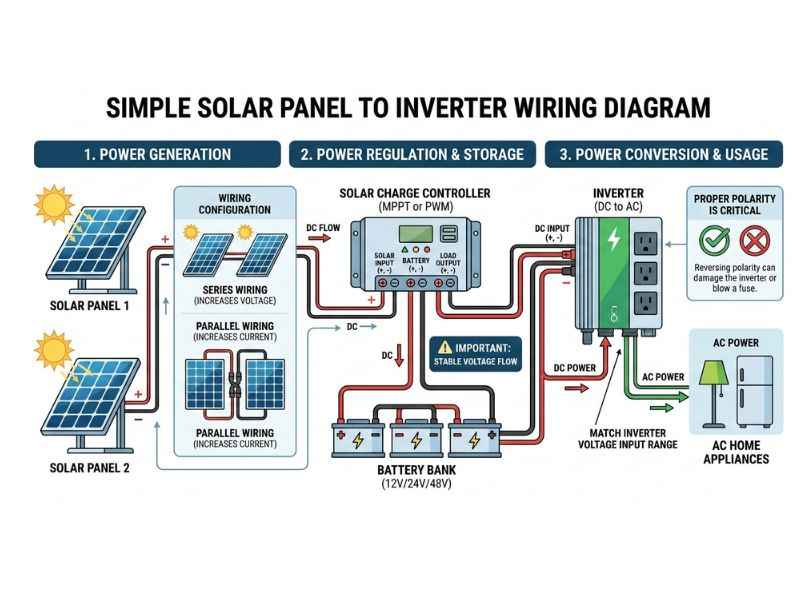
Solar Panel to Inverter Wiring Diagram (Simple Explanation)
Understanding the wiring layout is essential when learning how to connect solar panel to inverter safely. A simple diagram usually shows the solar panel connected to a charge controller, then to the battery, and finally to the inverter. This flow ensures stable voltage and protects your equipment.
Always pay close attention to positive and negative polarity. The positive (+) wire from the solar panel must connect to the positive terminal of the charge controller, and the negative (–) to the negative terminal. Reversing polarity is one of the fastest ways to damage your inverter or blow a fuse.
When connecting multiple panels, you can use series or parallel wiring. Series increases voltage, while parallel increases current. Voltage matching is critical—your total panel voltage must stay within the inverter or MPPT input range. If you truly understand voltage limits and polarity, mastering how to connect solar panel to inverter becomes much easier and safer.
Top 5 Inverters for Solar Panels to Consider
1. Renogy 1000W Pure Sine Wave Inverter 12V DC to 120V AC
The Renogy 1000W Pure Sine Wave Inverter is one of the most reliable inverters for solar panels if you’re running a 12V battery system. It delivers 1000W continuous power with a 2000W surge capacity, making it perfect for home backup, RV, and off-grid solar setups. With over 90% conversion efficiency, it minimizes energy loss from your solar battery bank.
Its pure sine wave output provides clean, grid-like AC power. That means your television, laptop, freezer, and other sensitive electronics run smoother, cooler, and quieter. For solar users, this is crucial because stable output protects appliances connected to your solar power system.
Safety is another strong point. It includes overload, over-temperature, short circuit, and voltage protection. Built-in USB ports, dual AC outlets, a terminal block, and a wired remote make it practical for everyday solar use. If you want dependable performance from your solar inverter, this is a solid choice.
🔑 Key Features
- Output Power: 1000W Continuous
- Peak Surge Power: 2000W
- Input Voltage: 12V DC
- Output Voltage: 120V AC
- Waveform: Pure Sine Wave
- Conversion Efficiency: >90%
- AC Outlets: 2
- AC Terminal Block: 1
- USB Port: 5V / 2.1A
- Protection Features: Overload, Over-temp, Short Circuit, Under/Over Voltage
- Cooling System: Dual High-Speed Fans
- Certifications: UL 458, CSA C22.2
- Included Cables: 2 × 3ft 4AWG
- Remote Control: 16.4ft Wired Remote
✅ Pros
- Pure sine wave for stable solar power
- Strong 2000W peak surge capacity
- Built-in safety protections
⚠️ Cons
- Remote cable could be longer
- Only 2 AC outlets (expandable with power strip)
📦 Kit Includes
- Renogy 1000W Pure Sine Wave Inverter
- 2 × 3ft 4AWG battery cables
- 16.4ft wired remote controller
- User manual
2. BELTTT 2000W Pure Sine Wave Inverter
The BELTTT 2000W Pure Sine Wave Inverter is a powerful choice if you need serious energy from your solar setup. With 2000W continuous power and a 4000W surge capacity, it easily handles heavy loads like refrigerators, pumps, and home appliances. That makes it one of the best inverter for solar panels for home backup systems running on 12V batteries.
Its pure sine wave output delivers clean, grid-like electricity, which is ideal for sensitive electronics and long-term off-grid use. With over 91% efficiency, it reduces energy loss from your solar battery bank. This means you get more usable power from your solar panels.
The intelligent LCD display shows real-time voltage and battery status, which is very helpful in solar power systems. Dual AC outlets, a 20A socket, USB port, hardwire option, and multiple safety protections make it a dependable inverter for solar panels in RV, truck, and off-grid home setups.
🔑 Key Features
- Output Power: 2000W Continuous
- Peak Surge Power: 4000W
- Input Voltage: 12V DC
- Output Voltage: 110V–120V AC
- Waveform: Pure Sine Wave
- Conversion Efficiency: >91%
- AC Outlets: Dual AC Sockets
- 20A Outlet: 1
- USB Port: 5V / 2.1A
- Hardwire Port: Yes
- Display: Intelligent LCD Screen
- Remote Cable Length: 23ft
- Protection Features: Overload, Over-temp, Short Circuit, Under/Over Voltage
- Housing: Aluminum + Reinforced Plastic
✅ Pros
- High 2000W continuous output
- Intelligent LCD for real-time monitoring
- Excellent safety protections
⚠️ Cons
- Larger size than small inverters
- Remote cable may feel long for some setups
📦 Kit Includes
- BELTTT 2000W Pure Sine Wave Inverter
- Wired remote controller (23 ft cable)
- User manual
3. Cantonape 3000W Power Inverter 12V to 110V/120V DC to AC
The Cantonape 3000W Power Inverter is a strong option for large solar setups that need higher output. It delivers 3000W continuous power with a 6000W surge, making it suitable for running heavy appliances from your solar battery system. If you need the best inverter for solar panels for RV trips or backup use, this one handles demanding loads with ease.
With four AC outlets and four 3.1A USB ports, it supports multiple devices at the same time. The >90% efficiency helps you get more usable energy from your solar panels. For RV solar systems or off-grid cabins, that extra efficiency really matters.
The intelligent LCD display shows voltage, battery level, and fault codes in real time. Built-in protections and a cooling fan keep your solar power system safe. It’s a practical inverter for solar panels when you want capacity, flexibility, and solid performance.
🔑 Key Features
- Output Power: 3000W Continuous
- Peak Surge Power: 6000W
- Input Voltage: 12V DC
- Output Voltage: 110V–120V AC
- Waveform: Modified Sine Wave
- Conversion Efficiency: >90%
- AC Outlets: 4
- USB Ports: 4 × 3.1A
- Display: Intelligent LCD (voltage, battery, load)
- Remote Control: Included
- Cooling System: Built-in temperature control fan
- Protection Features: Overload, Short Circuit, Overheat, Under/Over Voltage, Reverse Polarity
- Housing: Durable Aluminum Body
- Warranty: 12 Months
✅ Pros
- High 3000W continuous output
- Multiple AC outlets + USB ports
- Intelligent LCD for real-time monitoring
⚠️ Cons
- Modified sine wave (not pure)
- Larger and heavier than smaller inverters
📦 Kit Includes
- Cantonape 3000W Power Inverter
- Remote controller (requires 12V 23A battery, not included)
- User manual
4. EFFORTWAY 5000W Power Inverter DC 12V to AC 110V/120V
The EFFORTWAY 5000W Power Inverter is an excellent choice for large solar power systems that need serious output. With 5000W continuous power and a massive 10000W surge capacity, it can run heavy appliances like refrigerators, pumps, and power tools. This makes it one of the best inverter for solar panels for off-grid solar system setups.
Its high conversion efficiency (>90%) ensures you get maximum usable energy from your solar battery bank. This is especially important in off-grid solar systems where every watt counts. It converts 12V DC from solar batteries into stable 110V/120V AC power for home, RV, or backup use.
The LCD display shows real-time voltage, battery level, and load status for easy monitoring. The wireless remote control adds convenience, while built-in protections and cooling fans keep your solar inverter safe. It’s a reliable inverter for solar panels when you need high capacity and dependable performance.
🔑 Key Features
- Output Power: 5000W Continuous
- Peak Surge Power: 10000W
- Input Voltage: 12V DC
- Output Voltage: 110V–120V AC
- Conversion Efficiency: >90%
- Display: LCD Display (voltage, battery, load, error codes)
- Remote Control: Wireless remote (16 ft range)
- AC Outlets: 4
- USB Ports: 1
- Cooling System: High-performance cooling fans
- Protection Features: Overcurrent, Short Circuit, Overload, Overheat, Over/Under Voltage
- Housing: Durable Aluminum Alloy
- Battery Cables Included: Yes (2 pairs)
- Warranty: 12 Months
✅ Pros
- Very high 5000W continuous output
- Wireless remote + LCD for easy monitoring
- Strong safety protections
⚠️ Cons
- Requires large battery capacity
- Bigger and heavier than smaller inverters
📦 Kit Includes
- 5000W power inverter
- Wireless remote control
- 2 pairs of battery cables (red and black)
- User instruction manual
5. SUNGOLDPOWER 10000W 48V Solar Inverter
The SUNGOLDPOWER 10000W 48V Solar Inverter is built for serious solar power systems. With 10KW continuous output and 20,000W peak power, it easily supports large homes and offices. If you need the best hybrid inverter for solar panels, this all-in-one unit delivers performance and flexibility.
It features dual MPPT solar charge controllers and up to 200A battery charging. That means faster charging and better solar energy harvesting from your PV array. With a 500V DC input and split-phase 120V/240V output, it’s ideal for full home solar installations.
WiFi monitoring, multiple charging modes, and time-slot control make it smart and efficient. It supports AGM, Gel, Flooded, and Lithium batteries with BMS communication. For advanced off-grid or hybrid solar systems, this inverter offers power, control, and reliability in one package.
🔑 Key Features
- Output Power: 10,000W continuous
- Peak Power: 20,000W
- Input Voltage: 48V DC
- Waveform: Pure Sine Wave
- MPPT Solar Controllers: Built-in ×2
- Max Battery Charging: 200A
- PV Max Open Circuit Voltage: 500VDC
- AC Output: Split Phase 120V/240V (settable)
- Charging Modes: Hybrid, Utility Priority, Solar Priority, Solar Only
- Time-Slot Charging/Discharging: Yes
- Battery Compatibility: AGM, Gel, Flooded, Lithium
- Communication: WiFi, CAN, USB, RS485
- Protection Features: Over/Under Voltage, Overload, Overcurrent
- Smart Monitoring: Mobile App via WiFi
✅ Pros
- Huge 10,000W output with dual MPPT for strong solar harvesting
- Split-phase 120/240V support for home & office systems
- Smart monitoring via WiFi and multiple charging modes
⚠️ Cons
- More complex setup than smaller inverters
- Higher price (matches larger solar systems)
📦 Kit Includes
- SUNGOLDPOWER 10000W 48V Solar Inverter
- Wireless/WiFi module (built-in or included accessories)
- User manual
Common Mistakes to Avoid
When learning how to connect solar panel to inverter, voltage matching is the first thing you must check. If the solar panel voltage exceeds the inverter or MPPT input limit, it can permanently damage the unit. Many beginners also misunderstand how do a solar inverter work, especially how it converts stable DC input into usable AC power.
Reverse polarity is another common and costly mistake. Connecting positive to negative can blow fuses instantly or damage internal circuits. Skipping a fuse or breaker is equally risky because it removes an important layer of protection in your solar power system.
Undersized cables can overheat and cause voltage drops, reducing system efficiency. Also, never connect a panel directly to an inverter if the system requires a battery or charge controller. Understanding these basics makes how to connect solar panel to inverter much safer and more reliable.
Final Thoughts
Learning how to connect solar panel to inverter properly is not just about wiring—it’s about protecting your investment and ensuring long-term performance. When you follow the correct sequence, match voltage carefully, and use the right components, your solar system runs safely and efficiently for years.
If you’ve been unsure about how to connect solar panel to inverter, the key is choosing the right inverter for your setup. To make things easier, we’ve recommended 5 reliable solar inverters for your convenience, including models from EFFORTWAY, Cantonape, BELTTT, Renogy, and SUNGOLDPOWER. Each one suits different needs, from RV systems to large off-grid home installations.
Pick the inverter that matches your battery voltage, power requirement, and solar capacity—and you’ll be one step closer to a dependable solar power system.
FAQs: How to Connect Solar Panel to Inverter
1. Can I connect a solar panel directly to an inverter without a battery?
In most cases, no. If you’re learning how to connect solar panel to inverter, you should know that off-grid inverters usually require a battery and charge controller. Only certain grid-tie or hybrid inverters support direct panel input.
2. What size inverter do I need for my solar panel system?
Your inverter size should match your total load and battery voltage. A common rule is to choose an inverter rated 20–30% higher than your expected maximum power usage.
3. Do I always need a charge controller between the panel and inverter?
Yes, for most off-grid systems. A charge controller regulates voltage from the solar panel to prevent battery overcharging and inverter damage.
4. What happens if I connect the wrong polarity?
Reverse polarity can blow fuses, trigger protection systems, or permanently damage the inverter. Always double-check positive (+) and negative (–) terminals before turning the system on.
5. How do I know if my solar panel voltage matches my inverter?
Check the panel’s open-circuit voltage (Voc) and compare it with the inverter or MPPT input range. Staying within the recommended voltage range ensures safe and efficient operation.